Project Title - L.A.R.S (Line - following Autonomous Robotic System)
05.04.2026
About
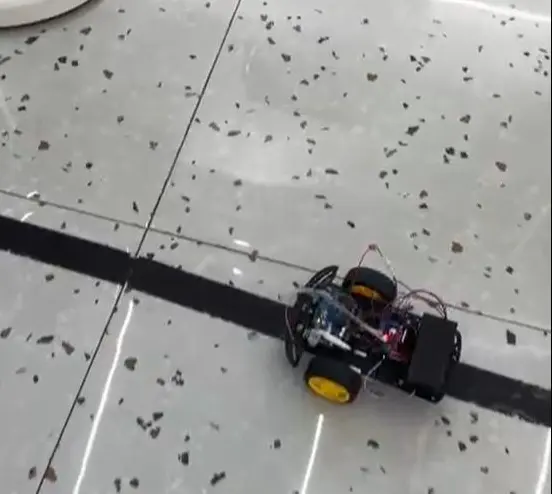
LARS (Line-following Autonomous Robotic System) is a low cost autonomous mobile system designed to follow a predetermined Black line on the ground using Infrared Sensors. The system utilizes an Arduino based control unit to process real time sensor data and adjust motor movement accordingly. The project demonstrates core concepts of embedded systems, sensor integration, and autonomous navigation in a simple and efficient manner.
Team
Nishanth Niresh Babu

He was in charge of the major building and testing phases. He helped in establishing the initial design and then proceeded to 3D print and build the robot. He then worked on the wiring and soldering of the robot. He also established the first attempt in the arduino programming for this robot.
Neal Monteiro

He spearheaded the project’s planning and calibration phases, playing a key role in drafting the initial proposal and refining the robot’s design. Additionally, he optimized performance by fine-tuning IR sensors to ensure precise line detection and fluid navigation during testing.
Introduction
Autonomous Robotic systems are now widely used in industrial applications. Companies such as Volkswagen are now using such systems on the assembly line to transfer parts from the storage area to the assembly line without having issues of conflict and inoperability. However, many advanced navigation systems rely on complex technologies such as Computer Vision or LiDAR, which increase cost and system complexity.
To provide a simpler and more cost-effective alternative, this project utilizes IR sensors to detect and follow a predefined path. The system demonstrates how basic sensor feedback combined with efficient control logic can achieve reliable autonomous navigation without the need for complex computation or expensive hardware.
Problem Statement
LARS aims to develop a low cost autonomous robot capable of accurately following a predefined path using IR sensors and real-time control through an Arduino-based system.
Objectives
- Design an autonomous IR-based line-following robot
- Develop an accurate path-following control algorithm
- Implement real-time sensor-based movement decisions
- Ensure smooth and stable navigation
- Achieve reliable performance under varying conditions
- Maintain a low-cost and simple system design
- Enable future upgrades like path planning and obstacle detection
EXISTING SYSTEMS
Most autonomous navigation systems rely on advanced technologies such as Computer Vision, LiDAR, or GPS-based localization. While these systems provide high accuracy, they are often expensive and computationally intensive.
Basic line-following robots exist as low-cost alternatives but may suffer from instability and limited accuracy. LARS improves upon these systems by optimizing sensor placement and control logic for better performance.
System Overview

Materials used
- Self Designed - 3D printed Chassis
- 2 x BO (Battery Operated) motors
- 1x Arduino UNO Board
- 2 x TCRT5000 IR Sensor Module
- 2 x Wheels
- 1 x Self Designed 3D printed Ball caster
- 25 x Jumper wires
- 1 x Battery pack (requires 6 x AA batteries)
MECHANICAL DESIGN
The LARS chassis is designed using CAD software and fabricated using 3D printing with PLA material. The structure is optimized for lightweight construction, stability, and proper alignment of sensors and motors.
A differential drive system using two BO motors enables controlled movement, while a rear ball caster provides balance and smooth motion.
Software and Programming


SYSTEM INTEGRATION
All components are integrated into a unified system where sensors, controllers, and actuators operate in real time.
The IR sensors provide continuous input to the Arduino, which processes the data and sends control signals to the motor driver. Proper wiring and power distribution ensure stable operation and reliable communication between components.
RESULT AND PERFORMANCE EVALUATION
The robot appeared to be jittering, at first but then upon closer examination of the Line, it was found that the line had some imperfections hence the robot was jittering after the sensors were reacting to the uneven parts of the line.
ADVANTAGES & LIMITATIONS
The advantage of the current system is that it can successfully and accurately follow a line using the inputs from the two IR sensors on the front of the robot and can do it with a lower cost than traditional systems.However, it is limited to not being able to do sharp turns effectively.
POTENTIAL IMPROVEMENTS
Potential improvements would be to adjust the sensor positions, software as well as the steering system to be well optimized for curved paths.
FUTURE SCOPE
The future scope would be to take the current system and optimize the programming and steering system to be able to overcome sharp bends in the path.
CONCLUSION
LARS demonstrates that reliable autonomous navigation can be achieved using simple sensor-based feedback and embedded control systems, making it an effective low-cost robotics platform.